
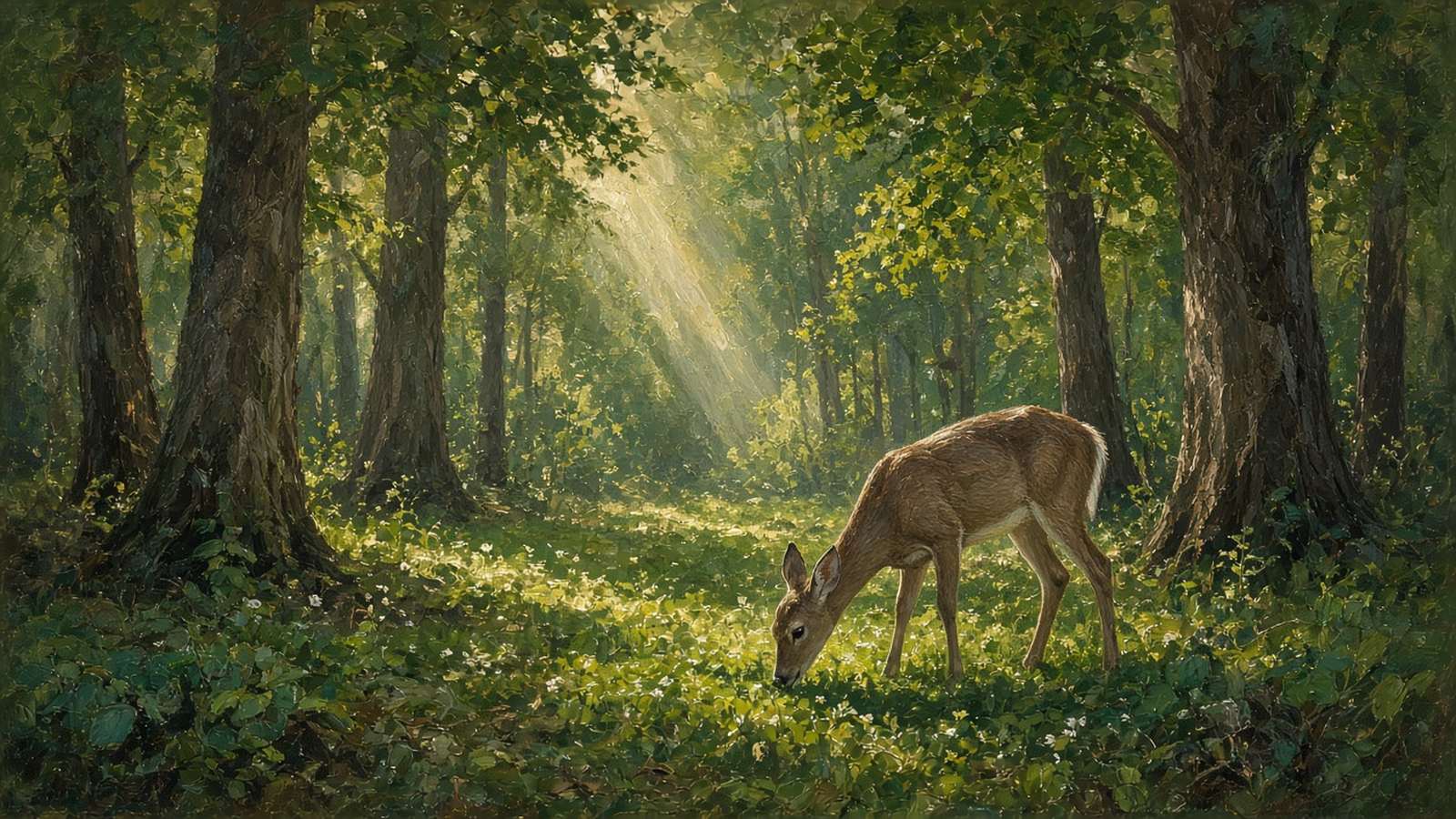
Plenty of hunters only have a small clearing, a logging road or a shady edge to plant. Shade cuts what you can grow, but it doesn't rule out a plot. This page covers what tolerates shade, the seed mixes the National Deer Association suggests for shady sites, and how to get more light to the ground. Everything here is researched, with sources at the end.
What tolerates shade
- Cool-season beats warm-season. A U.S. Forest Service review ranking 45 groundcovers found cool-season forages tend to be more shade tolerant than warm-season ones, with some exceptions.
- Cereal rye. NDA says it germinates very quickly, is highly preferred by deer, and has excellent resistance to grazing. It's the base of every NDA shady-site mix below.
- Clovers vary. Mississippi State Extension lists crimson clover as moderately shade tolerant, and Ladino and Durana white clover as mildly shade tolerant.
None of the university or NDA sources here gives a hard minimum of sun hours, so treat any single number you read with caution.
NDA's shady-site mixes
From NDA's "What Should I Plant in My Food Plot?":
| Mix | Seed per acre |
|---|---|
| Southern shady site | Crimson clover 5 lb, white clover 6 lb, subterranean clover 3 lb, rye 50 lb |
| Northern shady site | White clover 8 lb, rye 50 lb |
NDA says these are for less-than-ideal sites, and that heavy shade or wet ground may need special seed choices.
Let in more light
NDA's Kip Adams describes opening woods plots by cutting, or girdling and spraying, enough trees to open at least 40 to 50 percent of the canopy so sunlight reaches the ground. He also uses hinge-cutting around the lanes to build cover right away. And he says north-south strips next to timber let the trees shade clover during very hot spells, which can help it keep producing.
N.C. Cooperative Extension says to allow room from the woods edge to cut down shading from adjacent timber, and to keep plots no more than 50 yards from cover.
Set up the plot
- Test the soil first. NDA's clover guide says not to skip the soil test. See soil testing and lime.
- Keep it a hunting plot. Small woods openings make good hunting plots between bedding and food. See kill plots vs destination plots.
- Use roads and decks. NDA lists logging roads, firebreaks and logging decks as plot spots if they get enough sun.
- Plant without a tractor. See no-till food plots on a budget.
Seed to buy
Rye and clover are sold in bulk and in branded blends. For costs and how blends compare, see food plot seed, budget vs premium. My go-to seed is Domain Outdoor No BS, a no-till mix with forage oats, clover, forage rape, chicory and radish. I'm not claiming it's a shade mix.
Other good options
- Chicory in drier spots. NDA says chicory's long taproot helps it reach deep moisture and it can perform where perennial clovers can't in dry summers. It doesn't list chicory in its shady-site mixes.
- Several small plots. N.C. Extension says multiple small plots are better than a few large ones.
Questions hunters ask
What grows best in shade? In these sources, rye is the base of every NDA shady-site mix, and crimson clover is rated more shade tolerant than white clover by Mississippi State.
How much do I need to open the canopy? Adams opens at least 40 to 50 percent.
Can clover work in a woods plot? NDA's shady mixes include clover with rye. Mississippi State rates white clover only mildly shade tolerant.
Sources
- National Deer Association, "What Should I Plant in My Food Plot?": https://deerassociation.com/plant-food-plot/
- National Deer Association, "NDA's Guide to Clover Food Plots": https://deerassociation.com/clover-food-plots/
- National Deer Association, "Six Factors in Designing Successful Deer Hunting Plots," Kip Adams: https://deerassociation.com/six-factors-in-designing-successful-deer-hunting-plots/
- National Deer Association, "6 Tips for Designing Small Deer Hunting Food Plots": https://deerassociation.com/6-tips-for-designing-small-deer-hunting-food-plots/
- National Deer Association, "Chicory for Deer": https://deerassociation.com/chicory-for-deer/
- Mississippi State Extension, "A Cost-Production Comparison of Common Food Plot Plantings for Deer": https://cto.extension.msstate.edu/publications/cost-production-comparison-common-food-plot-plantings-for-deer
- N.C. Cooperative Extension, Burke County, "Cool Season Food Plot for Deer": https://burke.ces.ncsu.edu/news/cool-season-food-plot-for-deer/
- U.S. Forest Service, Van Sambeek et al., "Ranking the Shade Tolerance of Forty-five Candidate Groundcovers for Agroforestry": https://www.nrs.fs.usda.gov/pubs/jrnl/2007/nrs_2007_vansambeek_002.pdf