
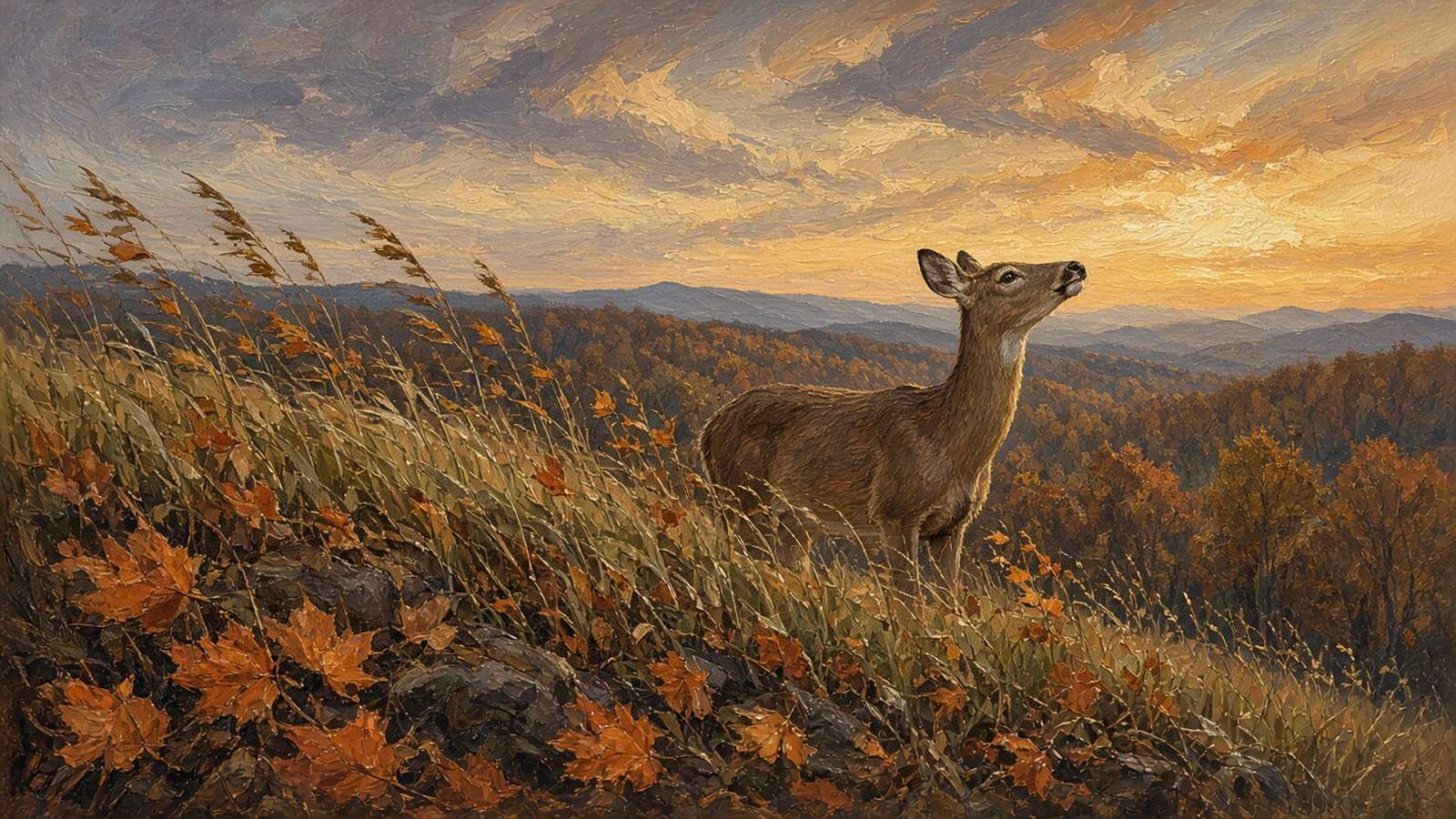
Wind beats almost every other detail in deer hunting. The National Deer Association cites research putting a whitetail's nose at around 297 million olfactory receptors, against about 220 million for a dog. If a deer is downwind of you, assume it can smell you.
You can't beat that nose. You can pick where your scent goes. This guide covers how scent moves, what thermals do to it, and how to plan a sit around both. In the tree, I check it with Windfloaters.
Picture a river of air
An NDA article by a longtime mature buck hunter describes air like water in a stream. It flows around trees, rocks, hillsides, and ravines. It speeds up, slows down, and forms eddies that can swing back the other way for a while.
Two things from that article are worth remembering:
- Light, variable wind is the tricky one. The author saw smoke travel downwind, hit an obstacle, split, and drift back upwind of the stand. He says that happens most on days with a slight breeze, usually under about 8 to 10 mph.
- Steady, stronger wind is more predictable. It pushes scent in a consistent direction, the classic "scent cone." The tradeoff he notes is that deer tend to move less when it's windy.
The same article says it often took three or four sits to learn the right wind and time of day for a new stand, and that he sometimes moved a stand a few yards after seeing where the smoke went.
Thermals: the wind under the wind
Thermals are air moving because of temperature. North American Whitetail describes the general pattern:
- Mornings: as the sun warms the ground, air starts to rise.
- Evenings: as the air cools, it sinks back downhill.
The same article calls that an oversimplification. Slope direction, sun, shade, and even cool water change the pattern. That's why a stand that works in the morning can carry your scent downhill to the deer in the evening, and why you check on site instead of trusting the rule.
The Southern Outdoorsmen podcast covers this in depth. Episode 385, "Catch the Bucks Where They've Been Busting You," is listed in its show notes as covering how bucks use thermals traveling back to bed in the morning, places where thermals get necked down and speed up, thermal switches for access, and thermal dead zones.
For the science behind thermals and the slope and timing exceptions, see thermals explained.
Plan the sit before you go
- Know which way the deer should come from. Bedding, food, and the travel between them.
- Pick a wind that carries your scent away from that path. A crosswind to the trail sends your scent off to the side instead of down it.
- Factor in thermals for the time of day. Morning uphill, evening downhill, then adjust for your terrain.
- Plan the walk in and out, not just the tree. NDA chief conservation officer Kip Adams told Outdoor Life that the best thing you can do is pick stand locations around wind direction, deer travel, and thermals, and plan your access, since deer can pick up ground scent from your tracks.
- Have a backup. If the wind is wrong for a stand, hunt a different one. A saddle makes that easier, since you can hunt almost any tree. For mapping property lines and terrain first, see how to use onX Hunt.
Two more Southern Outdoorsmen episodes go deeper on reading wind for mature bucks: episode 282, "The Wind Rule with Bill Vale," described in its notes as a theory of buck movement based on wind and thermals, and episode 213 with Travis Murray, which its notes say covers woodsmanship and how to understand a "killing wind."
Check it from the tree
A forecast is general. The air at your tree is what counts.
- Check at the base of the tree, before you climb.
- Check again once you're set up, since that's where your scent leaves from for the rest of the sit.
- Check through the sit, especially around sunrise and sunset when thermals turn.
I use Windfloaters for this. Illusion describes them as light natural fibers you release to show where wind and thermals are carrying your scent. The NDA author used a similar idea: a light, yarn-like material from fly fishing shops that he could see floating out to 20 or 30 yards or more. For a side by side with powder, see wind checkers compared.
Study the wind in the off season
The NDA article suggests making the wind visible when you're not hunting:
- A small smoky fire at home on different days, morning and evening, in high and low pressure, with notes on what the smoke does.
- Colored smoke at the stand site in the off season, set on the platform, to see where your scent really goes.
Wind checklist
- Expected deer travel marked before you go
- A wind that carries scent away from that travel
- Thermals considered for morning or evening
- Access route that doesn't cross where deer will be
- Wind checked at the base, at height, and during the sit
- A backup stand for the wrong wind
Other good options
Researched, not first-hand.
- Powder puffers like the Hunters Specialties Windicator. Cheap and easy. They show the air right in front of you.
- Scent control on a budget. Carrying less scent in buys you some margin when the wind isn't perfect. It doesn't replace playing the wind.
FAQ
What is the best wind for deer hunting? One that carries your scent away from where deer will come from and away from your access. There isn't one direction that works for every stand.
Do thermals matter more than wind? They matter most when the wind is light, especially near sunrise and sunset. In steady wind, the wind usually wins. Check both on site.
Should I hunt a stand on the wrong wind? Kip Adams' advice to pick stands around wind, deer travel, and thermals points to no. Hunt another stand, or wait for the right day.
Sources
- National Deer Association, To Kill Mature Bucks, Reveal the Wind (2014)
- North American Whitetail, The Thermal Factor
- Outdoor Life, Kip Adams (NDA) on a deer's sense of smell
- Southern Outdoorsmen, Ep. 385 show notes
- Southern Outdoorsmen, Ep. 282, The Wind Rule with Bill Vale
- Southern Outdoorsmen, Ep. 213 with Travis Murray
- Illusion Systems, PhaZe Windfloaters