
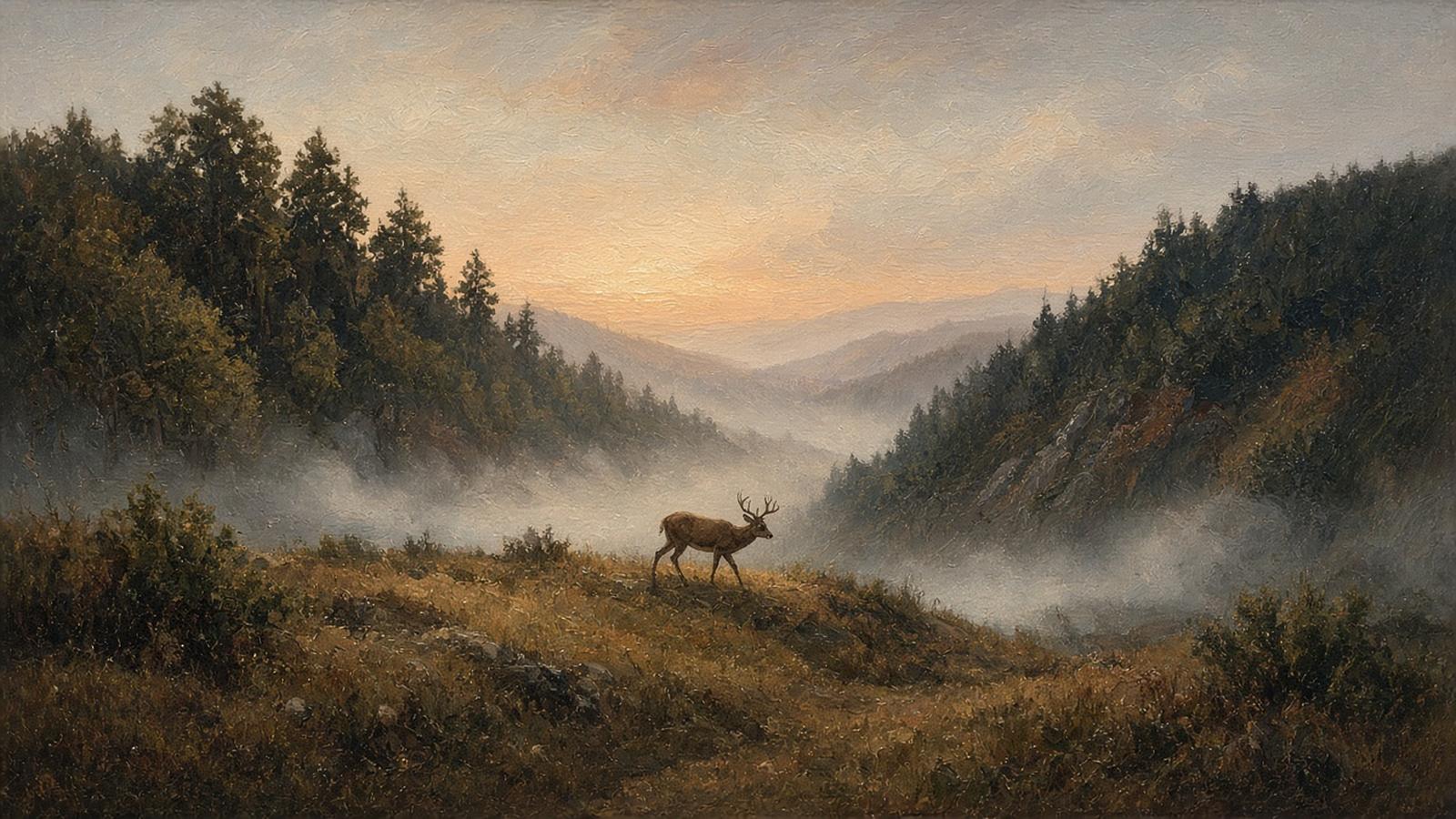
Deer don't spend energy they don't have to. That makes terrain predictable: low spots, narrow spots and gaps tend to funnel movement. This page explains the features, why they work and how to find them. Sources are at the end. (A terrain saddle is a landform. It has nothing to do with the tree saddle you hunt from.)
Why terrain funnels deer
NDA says deer use as little energy as they need to, because the more they spend, the more food they need. North American Whitetail calls deer "physiologically conservative": they'd rather walk a level line than climb a steep hill.
The features
| Feature | What it is | Why deer use it |
|---|---|---|
| Terrain saddle | A low spot on a ridge, or between two ridges | The easiest place to cross (NDA). American Hunter adds that it keeps a buck lower and out of sight |
| Bluff gap | A gap in a long bluff | Funnels movement through the bluff (NDA) |
| Along a cliff or bluff | Top or bottom edge | Funnels movement parallel to it (NDA) |
| Ridge narrows at a ravine head | Where a draw cuts up into a ridge | Deer on the side hill detour around the ravine head, close to the top (American Hunter) |
| Creek bend | An inside bend | Deer can funnel around it instead of crossing the creek several times (NDA) |
| Bench | A flat step on a slope | Can hold bedding. North American Whitetail mapped a winter bedding area on one |
North American Whitetail also reports that in one study, does stayed tied to their home drainages, while bucks moved between drainages through saddles.
Not all saddles are equal
NDA's advice:
- Find the harder-to-reach saddles that other hunters aren't already scouting.
- Pick saddles near good cover. NDA says mature bucks rarely expose themselves in open timber in daylight.
Find them on a map
- Topo lines. A saddle shows as a low spot between higher contours on a ridge. Bluff gaps can be hard to spot unless the lines are very close together, per NDA.
- Aerial photos. American Hunter says ridges show up well on aerials because of shadowing.
- Mapping apps. onX Hunt has terrain and 3D views. See how to use onX Hunt.
Set up on them
- Check wind and thermals first. See hunting the wind and thermals explained.
- Setting up in a tree saddle. See saddle hunting shot angles.
- Mark it with a camera. See trail cam placement for bowhunters.
Other good options
- Public land pressure. Hard-to-reach funnels pair well with walking past other hunters. See public land bowhunting for beginners.
- Kill plots in a funnel. See kill plots vs destination plots.
Questions hunters ask
What is a terrain saddle in deer hunting? A low spot on a ridge, or between two ridges, where deer are most likely to cross, per NDA.
Do bucks use saddles more than does? In the study North American Whitetail described, bucks moved between drainages through saddles while doe groups stayed in their home drainages.
Sources
- National Deer Association, "4 Terrain Features That Help Fill Deer Tags": https://deerassociation.com/4-terrain-features-that-help-fill-deer-tags/
- American Hunter, "How Bucks Use Terrain": https://www.americanhunter.org/content/how-bucks-use-terrain/
- North American Whitetail, "How to Utilize Topography and Terrain for Deer Management": https://www.northamericanwhitetail.com/editorial/topography-and-terrain-deer-management/519607